

The P95 Academy Facility opened on August 1, 2026, at 25323 Fulshear-Gaston Road in Richmond, giving Katy, Fulshear, and Richmond baseball families a new local training site built around measurable development rather than weekend-only exposure. The four-acre baseball and softball complex includes an indoor training space, full-length cages, outdoor field work, bullpen lanes, strength and conditioning, and athlete tracking tools, according to the Katy-Fulshear Times report.
For youth players, the main value is not one single feature. It is the mix of space, feedback, repeatable reps, and supervised training. A player can hit in a controlled cage setting, throw in a bullpen lane, move to a grass field for defensive or athletic work, then use data and video to understand what changed. That structure matters for families who want development plans grounded in observable progress instead of vague promises.
What The P95 Academy Facility Adds For Local Players
Indoor Reps With Game-Like Space
The indoor complex is reported at more than 5,000 square feet and climate-controlled, with three full-length 70-foot batting cages that include pitching mounds. That length is a meaningful detail for baseball and softball training because cage distance affects how hitters see timing, shape, and movement. Shorter cages can make pitch movement feel different than it does in a game setting. Longer cages give coaches more room to work on pitch recognition, swing timing, and mound-to-plate rhythm.
The P95 Academy Facility was also designed for year-round work in a region where heat, rain, and school schedules can interrupt practice plans. A climate-controlled indoor space does not replace live competition, but it helps protect a player’s weekly routine. For a hitter working on contact quality, a pitcher building a delivery, or a catcher receiving higher-velocity throws, that repeatable setting can keep training from becoming random.
Outdoor Field Work Beyond The Cage
The official P95 site lists outdoor training areas that include a full-length 100-yard grass field for speed, agility, long toss, and outfield defensive work, along with bullpen and outdoor pitching lanes through its P95 Academy training information. That matters because baseball skill does not develop only in cages. Players need room to run, decelerate, throw with intent, work on routes, build arm strength, and practice movement patterns that show up in games.
For outfielders, a longer grass field can support reads, angles, and throwing progressions. For infielders, the same space can help with acceleration, first-step quickness, and general athletic training. Pitchers can use outdoor lanes for mound work and throwing plans, while still connecting that work to strength, mobility, and arm-care habits.
How P95 Academy Facility Data Should Be Used
Metrics As Feedback, Not Labels
The facility uses TrackMan and Rapsodo systems, with slow-motion video paired with data evaluation. The reported metrics include exit velocity, launch angle, spin rate, pitch movement, and velocity. Those tools can be valuable when coaches use them as feedback. They are less useful when families treat a number as a player’s identity.
For a young hitter, exit velocity can show whether strength gains and barrel accuracy are showing up in ball flight. Launch angle can help identify whether a swing path is producing playable line drives or too many mis-hit balls. For pitchers, spin rate, movement, and velocity can help coaches see whether a grip change, delivery adjustment, or strength phase is affecting the ball in a measurable way.
The key is context. A 12-year-old, a freshman, and an upperclass varsity player should not be judged by the same standard. Coaches and parents should look for progress from a baseline, cleaner movement, better intent, and the ability to repeat changes under fatigue. For a deeper discussion on how families can read training technology without chasing empty numbers, Texas Elite Baseball has covered smart tech in youth baseball.
Baseline Testing And Training Plans
P95 describes its training as individualized through in-person assessments, baseline measurements, and custom strength-and-conditioning programs based on sport, goals, and current ability. That approach fits where youth baseball development is heading. The best programs do not hand every player the same throwing plan, lifting plan, or hitting cue. They start with where the athlete is, then build from there.
For youth players, the P95 Academy Facility can help turn training into a cycle: test, train, review, adjust, and retest. If a player’s bat speed improves but swing decisions fall off, the plan may need more pitch recognition. If a pitcher gains velocity but loses command, the delivery and workload need attention. If a player moves better in the weight room but still struggles on the field, the next phase may need more baseball-specific movement work.
Why Access And Scheduling Matter During School Months
Training Frequency With Family Structure
The Katy-Fulshear Times reported that youth athletes have access five days a week during the school year, with sessions scheduled through an app. Earlier descriptions in the research mentioned three days per week for certain membership tiers, so families should confirm the exact access rules for a specific program or membership before enrolling. The important development point is that scheduled access can help players avoid the common pattern of training hard for one week, disappearing for two weeks, then expecting progress to hold.
School-year baseball development works best when training fits homework, practices, tournaments, rest, and family time. Five-day access does not mean every player should train hard five days in a row. Younger athletes may need shorter sessions, more movement quality, and clear rest days. Older players may need more structured strength work, throwing plans, recovery, and skill blocks that match their school and travel schedule.
- Hitters can pair cage work with video review, tee work, front toss, and machine or mound-based timing reps.
- Pitchers can connect bullpen work with arm care, movement prep, recovery, and data review.
- Position players can use field space for defensive footwork, throwing progressions, speed, and agility.
- Multi-sport athletes can keep strength and movement plans organized without specializing too early.
The best use of access is planned consistency. Families should ask how coaches monitor workload, how often data is reviewed, how strength plans are adjusted, and how the staff communicates with parents and athletes.
Showcases, Instruction, And The Development Pathway
Exposure Built On Measurable Work
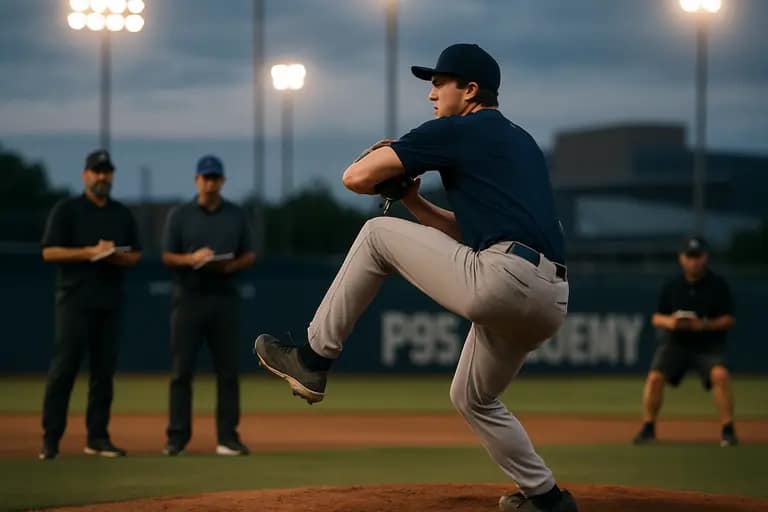
P95 functions as more than a training gym. The reported setup includes showcases where athletes can use full-length cages, open field space, and performance-tracking technology to display measurable information for college coaches and scouts. That does not mean every player who attends a showcase becomes a recruit. It means the facility has tools that can support cleaner presentation of player skills when an athlete is ready.
For Texas youth baseball families, that distinction matters. A showcase should not replace player development. It should reflect it. Players need enough training history to show repeatable mechanics, athletic control, and competitive habits. A radar reading, exit velocity number, or video clip has more value when it connects to consistent work over time.
Private Instruction Within A Bigger Plan
The facility offers private instruction in hitting and pitching, along with velocity training and arm-care programs. Private lessons can help when the coach, athlete, and family agree on a clear development target. A hitter might work on bat path, timing, or contact point. A pitcher might address delivery direction, lower-half sequencing, pitch shape, or recovery habits.
The risk with private instruction is isolated coaching. If a player hears one message in a lesson, another at team practice, and another from a parent after games, development slows. The value of a site like this comes from connecting instruction, strength work, field work, and data review so the athlete is not pulled in different directions.
What The P95 Academy Facility Means For Katy-Area Development
The P95 Academy Facility gives families west of Houston another option for structured baseball and softball development without requiring players to be tied to a specific team or organization. That open-access model can help athletes who need skill work outside their team calendar, multi-sport athletes who need flexible training blocks, and older players preparing for high school or college-style evaluation settings.
Its impact will depend on execution. Facilities do not develop players by themselves. Coaches, communication, training plans, workload management, and athlete buy-in decide whether the space produces lasting gains. The physical pieces are in place: 70-foot cages, outdoor field space, bullpen lanes, strength and conditioning, tracking technology, and scheduled access. The next step for each family is to ask how those pieces fit a player’s age, goals, health history, and competitive calendar.
For youth baseball in the Katy, Fulshear, and Richmond area, the P95 Academy Facility is best viewed as a development platform. Used well, it can help players build cleaner skills, measure progress, and prepare for higher levels with better information. Used poorly, it becomes just another place to swing, throw, and chase numbers. The difference comes from patient coaching, age-appropriate planning, and a steady focus on the player’s long-term path.