

Texas A&M Camps give youth baseball families a clear fall 2026 schedule to study before committing time, money, and weekend travel to College Station. As of September 7, 2026, the fall camp dates listed by Texas A&M remain ahead on the calendar, with offerings spread across exposure work, position-specific instruction, younger-player development, and multi-day prospect settings.
The official schedule lists 11 fall baseball camps hosted at Olsen Field at Blue Bell Park and/or the Texas A&M Baseball Player Development Center. Registration opened on July 1, 2026 for most listed camps, while the Aggie Experience camp dates opened on August 1, 2026, according to the official camp schedule. For Texas families—many of whom follow SEC athletics closely and check BetOnline user reviews while following fall sports—the main question is not simply whether a camp is available. The better question is whether the date, age band, format, capacity, and player goal match the athlete’s current stage.
Texas A&M Camps Schedule By Player Need
The fall slate covers several different player profiles. Some sessions are one-day evaluations or exposure-style settings. Others are built around narrower skill groups, such as pitchers and catchers, or hitting-specific evening work. The schedule also includes camps for younger players, which matters for families who want a college setting without placing an 8- to 12-year-old into an older prospect environment too early.
Texas A&M Camps For Older Players
The Aggie Experience Camp is scheduled for September 26, 2026 and October 24, 2026. Each date is a one-day session for graduates in the classes of 2027 through 2031, with times listed from 8:30 a.m. to 2:00 p.m. The cost is listed at $125, and capacity is 75 players per session. That format gives high school and near-high-school players a shorter camp window than a two-day event, which can fit families balancing fall tournaments, school work, football crossover schedules, or pitcher workload limits.
The Pitcher/Catcher Camp is scheduled for October 10, 2026. It is listed for ages 13 to 19, runs from 8:30 a.m. to 1:00 p.m., costs $250, and has a tighter capacity limit of 40 pitchers and 24 catchers. That lower cap changes the planning value. Pitchers and catchers often benefit from a smaller station structure because feedback can be more position-specific. Families should still judge fit by the player’s readiness to absorb instruction, not by the college brand alone.
Position And Exposure Formats
The Aggie Legends Camps are scheduled for November 1, 2026 and December 13, 2026. Eligibility is listed for players from eighth grade through high school seniors. Each date runs from 8:30 a.m. to 3:00 p.m., costs $300, and has a capacity of 44 players. That small listed number makes it a different planning decision than a larger open clinic. Families should review the player’s fall game calendar before registering, especially if the athlete has a tournament the prior weekend or a school throwing program in place.
The Fall Prospect Camp is scheduled for November 21-22, 2026. It is listed for ages 13 to 19, costs $500, and has a capacity of 60 players. Day 1 runs from 9:00 a.m. to 7:00 p.m.; Day 2 runs from 8:30 a.m. to 2:00 p.m. A two-day format creates more physical demand than a one-day camp, so families should plan sleep, meals, hydration, and post-camp recovery with the same care they would use for a tournament weekend.
Age Bands, Costs, And Capacity Limits
The schedule is not one-size-fits-all. Families with younger players have several different considerations than families with varsity-aged athletes. A younger player may gain the most from exposure to college-level instruction, field tempo, and basic skill checkpoints. An older player may be using the date to test current ability, gather feedback, and compare his routine against a more competitive peer group.
| Camp | Date Or Dates | Eligibility | Cost | Capacity |
|---|---|---|---|---|
| Aggie Experience | September 26 and October 24, 2026 | Classes 2027-2031 | $125 | 75 per session |
| Pitcher/Catcher | October 10, 2026 | Ages 13-19 | $250 | 40 pitchers, 24 catchers |
| Aggie Legends | November 1 and December 13, 2026 | 8th grade-high school seniors | $300 | 44 per session |
| Fall Prospect | November 21-22, 2026 | Ages 13-19 | $500 | 60 players |
| Fall Elite | December 5-6, 2026 | Ages 8-12 | $500 | 56 players |
| Premier Stars | December 12, 2026 | Ages 12-14 | $250 | 60 players |
Younger Player Camp Fit
The Fall Elite Camp is scheduled for December 5-6, 2026. It is listed for ages 8 to 12, with the same daily times as the Fall Prospect Camp: 9:00 a.m. to 7:00 p.m. on Day 1 and 8:30 a.m. to 2:00 p.m. on Day 2. The cost is $500, and capacity is 56 players. For younger players, families should be realistic about attention span, physical endurance, and how the athlete responds to correction in a longer day.
The Premier Stars Camp is scheduled for December 12, 2026. It is listed for ages 12 to 14, runs from 8:30 a.m. to 3:00 p.m., costs $250, and has a capacity of 60 players. This age band can be a useful bridge for players moving from youth baseball into more structured middle school and early high school development. The value is strongest when the family leaves with clear practice priorities rather than treating the day as a stand-alone event.
Hitting, Pitching, And Workload Planning
Hitting Under the Lights Camps are scheduled for November 20, December 4, and December 11, 2026. Each evening session is listed from 5:30 p.m. to 9:00 p.m., with eligibility for ages 7 to 19. The listed cost is $175, and capacity is 68 hitters per session. Evening hitting work can be easier for some families than a full weekend, but players still need to arrive fed, prepared, and ready to focus after a school day.
Pitcher And Catcher Readiness
Pitchers should treat the October 10 camp date as a throwing-calendar decision. The official listing provides the date, time, age range, cost, and capacity, but families still need to match the session against the athlete’s recent innings, bullpen volume, arm-care plan, and any school or travel-team limits. Catchers should consider workload too. A catcher coming off heavy fall tournament innings may need a lighter week before receiving, blocking, throwing, and instruction-heavy work.
Families comparing Texas A&M Camps with other regional options can use a simple development filter: What skill will be evaluated or trained, what feedback can the player act on, and where does the date fall in the athlete’s workload cycle? A camp that fits cleanly into the calendar often produces better learning than one squeezed between tournament weekends.
College Station Logistics And Facility Context
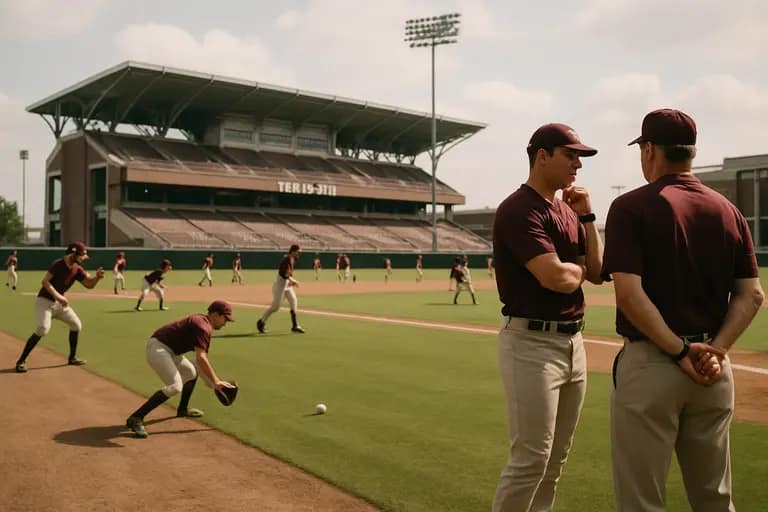
All listed events are tied to Olsen Field at Blue Bell Park and/or the Texas A&M Baseball Player Development Center. For Houston, Austin, San Antonio, Dallas-Fort Worth, East Texas, and the Valley, College Station travel can mean different departure times and overnight needs. Families should plan around check-in, parking, meals, weather, and recovery after the drive home.
Meals, Registration, And First-Come Access
Texas A&M’s July 16 athletics release states that campers should bring their own lunch or meals for multi-day camps, and that camps are open on a first-come, first-served basis while players must meet the listed age, grade, or gender eligibility criteria July 16 athletics release. Those details matter because several camps have listed capacity limits well below a large showcase field. Families should confirm the exact registration requirements through the official materials before making travel plans.
The camp materials also state that construction on a new Player Development Facility is ongoing, with new hitting cages and a pitching lab expected to open within the fall camp timeframe. Since the wording is expectation-based, families should not assume every facility element will be available for every date. The safer approach is to register for the instruction, schedule fit, and age-appropriate format rather than for a specific facility feature.
For a related planning angle, families can compare this schedule with our fall development primer, which focuses on age groups, position work, and College Station trip planning.
What Texas A&M Camps Mean For Fall Planning
Texas A&M Camps can serve different roles depending on the player. A 12-year-old may need a confidence-building instructional setting. A 15-year-old pitcher may need feedback on delivery, command routines, and catcher communication. A 17-year-old may need a more demanding environment that tests preparation habits. The schedule gives families choices, but the best choice is the one that matches the player’s age, body, workload, and current training goals.
Before registering, families should write down one primary objective for the camp. That objective might be improving swing direction, learning catcher receiving cues, testing mound routines, seeing how a player handles a college facility, or getting a clearer sense of the athlete’s next training block. If the goal is clear before the trip, the player is more likely to leave College Station with useful takeaways rather than only a camp shirt and sore legs.
The fall 2026 schedule is detailed enough for serious planning. The dates, costs, age bands, and capacity limits are published, and the first sessions begin on September 26, 2026. Families who treat the schedule as part of a broader development plan will get more out of the opportunity than families chasing every available event. The camp should support the player’s growth, not overload the calendar.