

Texas Twelve Cap City 14U Maroon delivered a championship performance on October 11, 2026, defeating ThaShow/WID Elite 14U 3–1 in the Perfect Game October Breast Cancer Pink Out Major final at CTX Field of Dreams in Dripping Springs, Texas.
Texas Twelve Cap City’s championship run also highlights the growing attention surrounding competitive sports across Texas, where youth baseball development, college athletics, and professional competition attract different audiences. While the October 14U Major final was strictly a youth sporting event, broader discussions about the state’s sports industry also include Texas sports betting legal updates, which examine the regulatory landscape surrounding adult sports wagering. That subject remains separate from youth baseball, where the focus should stay on player development, responsible coaching, teamwork, and competitive opportunities for young athletes.
The victory capped a demanding Sunday for the Austin-area program. Texas Twelve won three consecutive elimination games, beginning with an 8–3 victory over Austin Dirt Dawgs, followed by a narrow 5–4 semifinal win against TEST Black. The team then held ThaShow/WID Elite to one run in the championship game.
The result highlights several qualities that matter in competitive Texas youth baseball: the ability to win multiple games in one day, respond to close-game pressure, manage pitching resources, and execute against opponents with different strengths.
Perfect Game’s official 14U Major championship bracket confirms Texas Twelve’s three elimination-round victories and its championship result.
For TexasEliteBaseball.org, the tournament offers an opportunity to examine what a successful fall championship reveals about player development at the 14U Major level—and why winning consistently requires more than individual athletic talent.
Texas Twelve Cap City’s Road To The October Championship
The October Breast Cancer Pink Out took place October 10–11 at CTX Field of Dreams, a youth baseball complex in Dripping Springs, southwest of Austin.
The tournament featured multiple age groups and competitive classifications, with the 14U Major division bringing together eight teams in its championship bracket.
Texas Twelve Cap City 14U Maroon entered the elimination stage as the No. 1 seed. ThaShow/WID Elite 14U occupied the No. 2 position, setting up a potential championship meeting between the bracket’s two highest-seeded teams.
Both organizations advanced through their respective sides of the bracket, ultimately meeting in the final.
Texas Twelve’s championship path included three different competitive situations.
| Round | Opponent | Result | Scheduled Start |
|---|---|---|---|
| Quarterfinal | Austin Dirt Dawgs | Won 8–3 | October 11, 10 a.m. |
| Semifinal | TEST Black | Won 5–4 | October 11, 2 p.m. |
| Championship | ThaShow/WID Elite 14U | Won 3–1 | October 11, 6 p.m. |

All three games were listed on CTX Field of Dreams Field 12.
The quarterfinal provided Texas Twelve with a five-run victory, while the semifinal required the team to protect a one-run advantage.
The championship presented another challenge, with the eventual winner scoring only three runs.
Across the three bracket games, Texas Twelve scored 16 runs and allowed eight, producing a plus-eight run differential.
That progression is significant because it demonstrates that the team did not need the same offensive output to win every game.
Texas Twelve scored eight runs in its opening elimination game, five in the semifinal, and three in the final. Its opponents scored three, four, and one, respectively.
The declining scoring totals suggest that run prevention became particularly important as the bracket advanced, although the final scores alone do not establish which individual defensive plays or pitching decisions produced those results.
The team’s ability to win both a high-scoring contest and a lower-scoring championship is an encouraging indicator of competitive adaptability.
How Texas Twelve Handled Three Elimination Games In One Day
One of the defining characteristics of high-level youth tournament baseball is the compressed schedule.
Unlike a traditional high school season, where teams may have several days between games, travel baseball tournaments frequently require multiple contests within a short period.
Texas Twelve’s October 11 schedule illustrates that challenge.
The team’s quarterfinal began at 10 a.m., its semifinal was scheduled for 2 p.m., and the championship was listed for 6 p.m.
That meant the coaching staff had to prepare its players for three games across an eight-hour span of scheduled start times.
At the 14U level, managing that workload involves more than selecting the strongest lineup.
Coaches must consider pitching availability, defensive substitutions, player fatigue, hydration, recovery, and the possibility of additional innings or unexpected delays.
A team that performs well early in the day can still struggle in the championship if players become fatigued or the pitching staff lacks sufficient depth.
Texas Twelve avoided that outcome.
Its 5–4 semifinal victory over TEST Black was particularly important because it kept the team in contention without requiring another game to determine its place in the final.
The one-run margin also created a different competitive environment from the quarterfinal.
In close games, routine defensive plays, disciplined baserunning, and avoiding unnecessary outs become especially valuable.
The official bracket does not establish how Texas Twelve scored its decisive semifinal run or which pitchers appeared in each game. Those details should not be inferred from the final score.
However, the results confirm that the team successfully navigated three elimination games against increasingly demanding opposition.
For coaches developing elite youth players, that is one of the most relevant lessons from the tournament: competitive preparation must account for an entire event, not merely the opening game.
ThaShow/WID Elite Also Earned Its Place In The Final
The championship result deserves attention, but so does the path taken by Texas Twelve’s opponent.
ThaShow/WID Elite 14U, the No. 2 seed, advanced through the opposite half of the bracket with two victories on October 11.
The team defeated Action 14 Kelly 9–5 in the quarterfinals before beating MBG Red 14U 6–3 in the semifinal.
That gave ThaShow/WID Elite a place in the 6 p.m. championship against Texas Twelve.
The final was significantly lower-scoring than either of ThaShow/WID Elite’s previous elimination games. After scoring 15 runs across the quarterfinal and semifinal, the team managed one run against Texas Twelve.
This contrast makes the championship especially interesting from a player-development perspective.
Strong youth teams must learn to adjust when an opponent limits their preferred offensive approach. A lineup that produces multiple runs in one game may encounter better pitching, stronger defensive execution, or different game conditions in the next.
The bracket does not provide enough information to identify which of those factors determined the final. Nevertheless, the 3–1 result demonstrates how narrow the margin can become when two successful teams meet for a championship.
ThaShow/WID Elite’s runner-up finish also reinforces the competitive depth of Central Texas travel baseball.
Programs from communities around Austin, Kyle, Round Rock, and Dripping Springs regularly encounter one another through regional tournament competition.
Those repeated matchups can help players become familiar with stronger opponents and the standards required to compete in higher classifications.
For Texas Twelve, defeating a No. 2 seed that had already scored nine and six runs in its earlier bracket games made the championship a meaningful competitive achievement.
Perfect Game Recognized Raiden Delgado And Jakkson Smith
The October tournament also produced two individual award recipients.
Perfect Game’s official event results identify Raiden Delgado as the Most Valuable Player and Jakkson Smith as the Most Valuable Pitcher.
The same event summary confirms Texas Twelve Cap City 14U Maroon as champion, ThaShow/WID Elite 14U as runner-up, and TEST Black as the third-place finisher.
These awards add individual recognition to a weekend primarily defined by team competition.
At the youth level, tournament awards can provide useful encouragement, but they should be interpreted within the context of player development rather than treated as definitive projections of future success.
A Most Valuable Player award recognizes performance within a specific event. It does not establish that the recipient is the highest-ranked prospect in the age group or guarantee future high school or college success.
Likewise, a pitching award highlights an achievement during tournament competition without automatically establishing long-term durability or future pitching potential.
The official event summary names Delgado and Smith but does not, by itself, provide a complete statistical explanation for the award selections. Specific hitting totals, innings pitched, or strikeout numbers should therefore not be attributed to their October performances without additional game-level verification.
For young athletes, the broader value of recognition lies in reinforcing preparation, teamwork, and continued improvement.
What Makes 14U Major Baseball Different From Other Youth Divisions?
The 14U Major classification represents an advanced competitive environment within Perfect Game’s youth tournament structure.
Perfect Game organizes many tournaments by age group and classification, allowing teams to compete against opponents with broadly comparable competitive backgrounds.
Major-level competition generally attracts stronger and more experienced travel baseball programs than developmental classifications.
However, classification alone does not guarantee that every player is an elite college prospect or that every team will eventually compete at a national championship level.
At 14U, players are approaching an important developmental transition.
Many are preparing for high school baseball, where the physical demands, pace of play, and competition for roster positions can become substantially more challenging.
Players must improve their technical skills while learning to make decisions more quickly.
Hitters face pitchers with developing secondary offerings and greater command. Pitchers encounter lineups capable of making more consistent contact. Defenders must execute routine plays under increased pressure.
The 14U Major environment provides opportunities to experience those challenges before players enter older high school age divisions.
Perfect Game’s official October Breast Cancer Pink Out event information identifies the competition’s eligibility requirements, bat restrictions, and tournament format.
The tournament allowed eligible players born on or after May 1, 2012, or meeting its listed graduation-year criteria.
It also permitted approved metal, composite, or wood bats.
These rules establish the framework for competition, but they do not replace the importance of coaching and long-term development.
The most successful youth programs use tournament environments to teach skills that remain valuable as players advance.
Pitching Depth Is Essential In Championship Brackets
Texas Twelve’s championship run offers a useful example of why pitching management matters during youth tournaments.
Three elimination games in one day create a difficult challenge for any coaching staff.
Pitchers must be available across multiple games, and coaches must manage workloads responsibly.
A team that relies too heavily on one pitcher may struggle to maintain effectiveness throughout a tournament.
At the 14U level, protecting young athletes from excessive throwing demands is particularly important.
Pitching development should prioritize repeatable mechanics, appropriate recovery, command, and long-term physical health rather than short-term tournament results.
The MLB Pitch Smart guidelines provide age-based recommendations concerning pitch counts, rest periods, and responsible pitching practices.
These guidelines are especially relevant for teams competing in tournaments where multiple games take place on the same day.
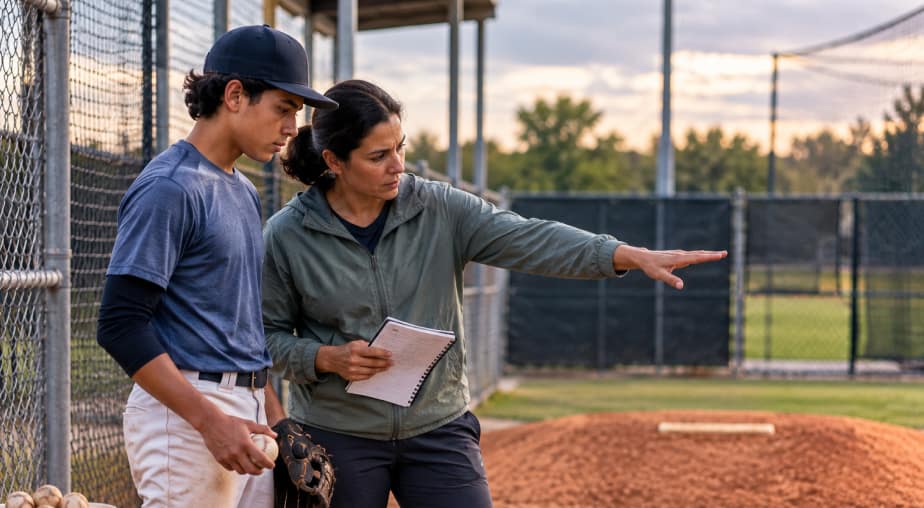
The October championship scores show that Texas Twelve allowed eight runs across its three elimination games, including only one in the final.
That is a meaningful team-level result.
However, the scores do not establish how many pitchers Texas Twelve used, how many pitches they threw, or whether specific pitching decisions determined the championship.
Those details require official pitching reports or verified game records.
The broader developmental lesson remains clear: a competitive youth program needs more than one capable arm.
Building pitching depth allows teams to distribute responsibilities while helping players develop at appropriate rates.
Defensive Execution Can Decide Close Tournament Games
Texas Twelve’s 5–4 semifinal and 3–1 championship illustrate the importance of winning games when offensive production is limited.
At the 14U level, defensive execution becomes increasingly important because opponents are more capable of capitalizing on mistakes.
Routine ground balls, accurate throws, catcher communication, and outfield positioning can influence close games.
Teams must also manage situations involving runners in scoring position.
A defensive mistake with two outs can extend an inning and create additional scoring opportunities.
Conversely, a well-executed defensive play can preserve a narrow lead.
The championship result does not identify particular defensive plays made by Texas Twelve, but the final score demonstrates that the team finished the tournament while allowing relatively few runs.
For youth coaches, that outcome reinforces the value of practicing fundamentals under game-like conditions.
Players should learn to execute defensive responsibilities when fatigued, communicate effectively, and maintain concentration during long tournament days.
Those skills are transferable to high school baseball, where stronger opponents frequently expose weaknesses in defensive preparation.
Why Fall Championships Matter For Long-Term Player Development
The October 11 championship took place during the fall baseball season, a period that can serve an important developmental purpose for youth athletes.
Fall tournaments allow players to apply skills developed during summer training and identify areas requiring improvement before the next competitive cycle.
For 14U teams, this period can be particularly useful because many athletes are preparing for high school baseball.
Coaches can evaluate whether hitters are adjusting to better pitching, whether pitchers are improving command, and whether defenders can execute consistently against stronger opponents.
Tournament success provides one measure of progress, but it should not become the only objective.
A team may win a championship while still identifying weaknesses in baserunning, offensive decision-making, or defensive communication.
Similarly, a team that loses a close game may demonstrate meaningful improvement in its preparation and execution.
The most productive development environments balance competitive expectations with individual growth.
For Texas Twelve, the October championship confirms success within a specific tournament. Its longer-term significance will depend on how the players continue developing throughout the 2026–27 season.
That distinction matters because youth baseball development is rarely linear.
Players mature physically at different rates, and performance at 14U does not guarantee future recruiting outcomes.
Coaches and families should therefore evaluate progress over months and seasons rather than relying exclusively on a single weekend.
Central Texas Continues To Provide Competitive Youth Baseball Opportunities
The October Breast Cancer Pink Out reflects the broader strength of organized youth baseball in Central Texas.
The region includes established baseball communities around Austin, Round Rock, Georgetown, Kyle, Cedar Park, and Dripping Springs.
Facilities such as CTX Field of Dreams provide venues for tournament competition involving organizations from across the region.
These events create opportunities for players to face unfamiliar opponents, adapt to different playing conditions, and experience elimination-round pressure.
For families, however, competitive travel baseball also involves practical considerations.
Tournament participation can require transportation, lodging, registration fees, equipment expenses, and significant time commitments.
Those demands make it important for programs to establish clear developmental priorities.
Families should understand what athletes are expected to learn from tournaments and how competition fits into their overall training schedules.
More tournament appearances do not automatically produce better baseball players.
Effective practice, appropriate rest, knowledgeable coaching, and consistent skill development remain essential.
The October event also carried a breast cancer awareness theme, demonstrating how youth sports organizations can connect competitive events with broader community interests.
However, the event’s name alone does not establish specific fundraising totals or charitable contributions. Such outcomes would require separate confirmation from organizers.
What Texas Twelve’s Championship Reveals About Elite Youth Baseball
Texas Twelve Cap City 14U Maroon’s October championship offers several useful lessons about competitive youth baseball.
The team entered the elimination bracket as the No. 1 seed and won three games against Austin Dirt Dawgs, TEST Black, and ThaShow/WID Elite.
Its scoring output varied across those games, but the team continued advancing.
The 8–3 quarterfinal demonstrated an ability to create offensive separation.
The 5–4 semifinal required success in a close contest.
The 3–1 championship showed that Texas Twelve could secure the tournament title in a lower-scoring game.
Together, those results illustrate the value of adaptability.
Elite youth teams need players who can perform in different situations rather than depending on one style of play.
They also need coaches capable of preparing athletes for compressed schedules, maintaining competitive focus, and balancing immediate results with long-term development.
Texas Twelve’s victory should be recognized as a meaningful tournament achievement, not as proof of future recruiting success or an established national ranking.
For the players involved, the more important opportunity is to build on the experience.
The championship provides evidence of what the team accomplished on October 11, 2026. The next stage involves translating that success into improved individual skills, stronger team execution, and continued progress toward high school baseball.
As Central Texas travel baseball continues to provide competitive opportunities, tournaments like the October Breast Cancer Pink Out demonstrate how meaningful development can emerge from the combination of preparation, competition, and teamwork.